
You’re driving home at night and notice strange glowing rings around every streetlight and oncoming headlight. It’s distracting, a little unsettling, and it makes you wonder if something is wrong with your eyes.
At Warman Eyecare, we see this concern often, and there are clear reasons why it happens. If you’ve been seeing halos, a comprehensive adult eye exam is the most direct way to identify the cause.
Halos around lights happen when something disrupts how light enters and focuses in your eye. Causes range from an outdated prescription to common vision issues, though persistent or sudden changes are worth having checked.
What Halos Around Lights Actually Are
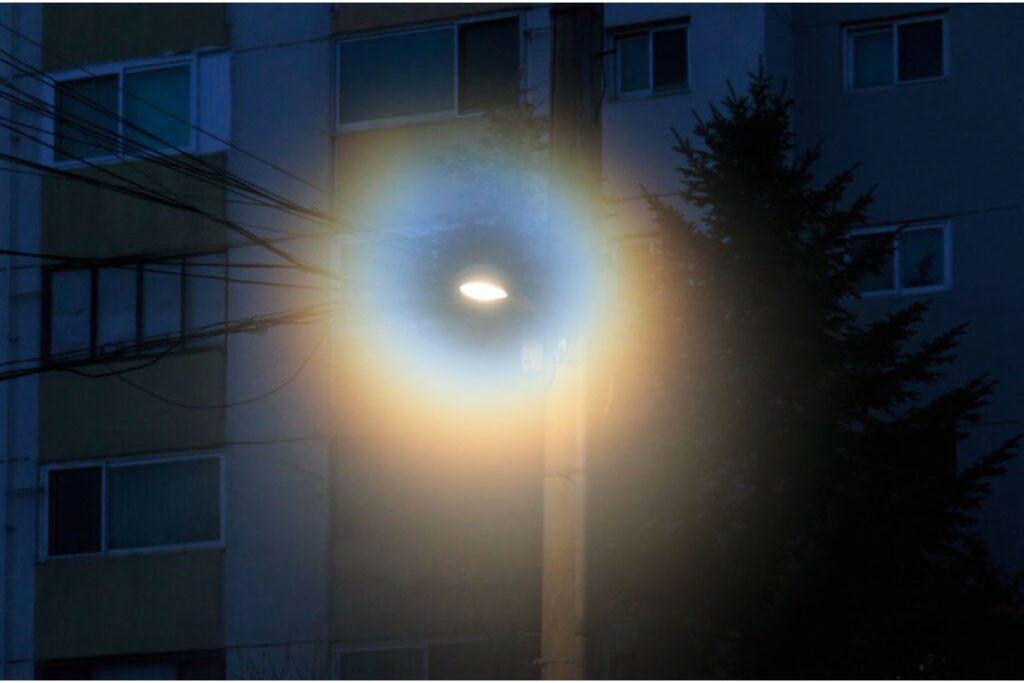
A halo is a bright ring or circle that appears around a light source—think streetlights, headlights, or lamps. This happens when light scatters instead of focusing to a single point on the retina, creating a glow or ring around the source.
They show up most noticeably at night when your pupils are wider and light contrast is higher. Wider pupils let in more light, which can increase how much that light scatters inside the eye. For some people, halos are an occasional nuisance. For others, they make night driving genuinely difficult.
Common Causes of Halo Vision
Eye Conditions That Affect Light Bending
Astigmatism is one of the most frequent reasons people see halos. When the cornea has an uneven shape, light doesn’t focus evenly, which can make bright lights appear stretched or surrounded by a glow.
Cataracts cause a similar problem—the clouded lens of a cataract distorts light as it passes through, creating that soft glow around bright sources. Dry eye can also play a role in seeing halos, as an unstable tear film changes how light hits the surface of your eye.
Other Factors Worth Knowing
Nearsightedness—especially in low light—can make halos more pronounced since your eyes are already working harder to focus at distance. Even wearing glasses or contact lenses can introduce minor halos, particularly if your prescription is off or your lenses have smudges or scratches. These causes are usually straightforward to correct once identified.

When Halos Are a Warning Sign
Symptoms That Need Prompt Attention
Most halos are not emergencies, but some combinations of symptoms are worth taking seriously. If halos appear suddenly alongside eye pain, that could point to acute glaucoma—a condition where pressure builds quickly inside the eye. Halos paired with nausea, a headache, or blurred vision are another reason to seek emergency eye care rather than wait.
Glaucoma & Cataract Halos
Glaucoma-related halos often appear as rainbow-coloured rings and tend to come on suddenly. Cataract halos, on the other hand, look like a soft, hazy glow that gradually worsens over time. During a thorough exam, your eye doctor can check the shape of your cornea, the lenses of your eyes, and your eye pressure to help pinpoint what’s going on.
Why a Full Exam Matters
Many of the conditions that cause halos share similar-looking symptoms, which makes self-diagnosing tricky. A comprehensive eye exam can distinguish between these potential issues by looking at what’s actually happening inside your eye. Catching a problem like glaucoma or cataracts early can help manage the condition before it progresses further.
What Can Be Done About Halo Vision
Treatment Depends on the Cause
The good news is that halos are often treatable once the root cause is found. For instance, dry eye treatment can reduce light scatter by stabilising the tear film. An updated prescription can significantly reduce halos linked to refractive issues. For cataracts or glaucoma, your eye care team can guide you through targeted management options suited to your situation.
Next Steps at a Local Eye Clinic
A comprehensive eye exam is where answers start. It’s the most direct way to identify what’s causing the halos and what can be done about it. If surgery is something you’re considering down the road, a laser eye surgery consultation is also available to walk you through your options.
At Warman Eyecare, the team is here to help you understand what your eyes are telling you—and to find the right path forward. If halos around lights have been bothering you, book your eye exam in Warman today and get the clarity you’re looking for.